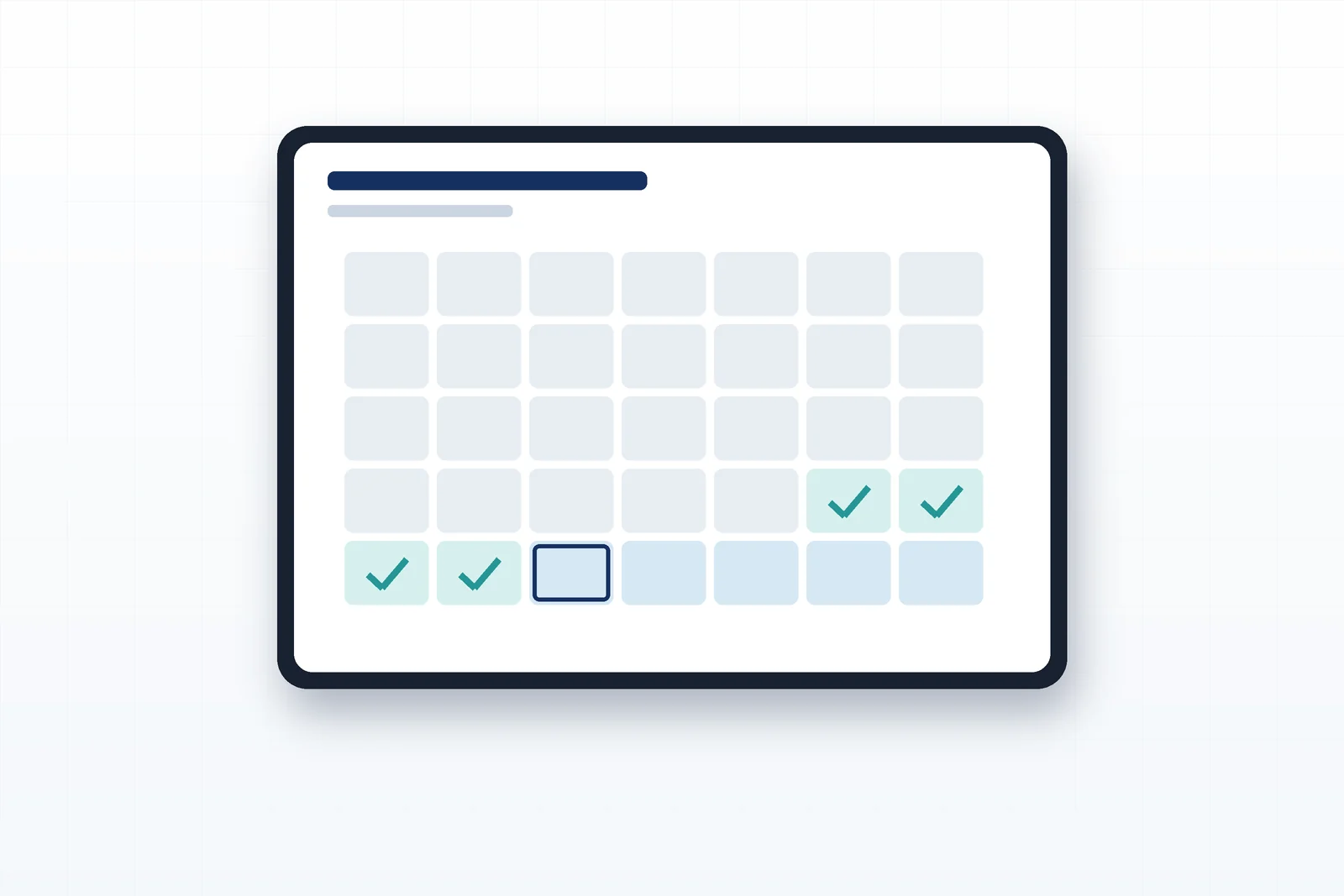
The month-end close is the set of tasks a finance team completes after the last day of each month so that the general ledger is complete, accurate and ready for reporting. A good close finishes in three to six working days, follows the same checklist every month, and ends with a locked period that nobody can change by accident.
This guide gives you a 12-step checklist, a day-by-day calendar, the adjusting entries most businesses need with real numbers, and the controls that keep the close short. The examples use a distributor, Atlas Office Supply, closing October 2026.
Month-end close at a glance
- Goal: complete and correct books for the month, signed off and locked.
- Typical length: three to six working days for a small or mid-sized business.
- Core outputs: reconciled balance sheet, trial balance, income statement, balance sheet, cash flow and a short variance commentary.
- Biggest time sinks: waiting for missing documents, unexplained bank items and intercompany differences.
- Last step: set a lock date so the reported month cannot be edited.
How long should the month-end close take?
There is no official standard, but survey data gives useful reference points. FloQast's State of Accounting AI 2026 report, as covered by IT Brief UK (August 2026), found that the most AI-mature teams complete the monthly close in 6.7 days on average, against 8.7 days for the least mature. The report attributes the gap to documented workflows and governance more than to the tools themselves.
For a single small company with clean subledgers, three working days is a realistic target. A group of several entities with inventory and intercompany trading usually needs five.
The 12-step month-end close checklist
- Enforce cut-off. Make sure every sale, purchase, receipt and payment dated in the month is recorded in the month, and nothing from next month has crept in.
- Complete the subledgers. Post all sales and purchase invoices, credit notes, stock documents and production orders for the month.
- Reconcile bank and cash. Agree every bank and cash account to the statement balance and explain each reconciling item.
- Reconcile receivables. Agree the receivables control account to the customer balances and review the aged list for doubtful amounts.
- Reconcile payables. Agree the payables control account to supplier balances and compare large suppliers with their statements.
- Reconcile intercompany balances. Confirm that each "due from" in one entity equals the "due to" in the other.
- Reconcile inventory. Agree the stock ledger to the inventory accounts in the general ledger and investigate any difference.
- Post accruals and deferrals. Accrue expenses incurred but not billed, release prepayments and recognise deferred revenue earned.
- Post depreciation and amortisation. Charge the month's depreciation on fixed assets and amortisation on intangibles.
- Revalue foreign currency balances. Restate monetary items in foreign currency at the month-end rate.
- Review the trial balance and statements. Compare with budget and last month, explain every material movement and fix errors.
- Sign off and lock the period. Approve the month and set the lock date to its last day.
A 5-day month-end close calendar
| Day | Tasks | Owner |
|---|---|---|
| Day minus 2 | Send reminders for expense claims, supplier invoices and timesheets; confirm cut-off with the warehouse | Finance lead |
| Day 1 | Post remaining invoices and stock documents; reconcile bank and cash | Bookkeeper |
| Day 2 | Reconcile receivables, payables and intercompany balances; agree differences with the sister company | Accountant |
| Day 3 | Inventory reconciliation, costing and overhead entries; accruals, prepayments, deferred revenue | Accountant |
| Day 4 | Depreciation, FX revaluation, trial balance review, budget vs actual commentary | Accountant and finance lead |
| Day 5 | Final review, sign-off, lock date, reporting pack | Finance lead |
Day 1 is the first working day after month end. Moving work before the month ends (reminders, recurring accruals prepared in draft) is the easiest way to shorten the calendar.
What should be reconciled at month end?
Every balance sheet account should be reconciled to independent evidence at least monthly for material accounts and quarterly for the rest. A reconciliation is not a glance at the balance: it is a schedule that shows the ledger balance, the evidence balance and each explained difference.
| Account | Evidence | Typical reconciling items |
|---|---|---|
| Bank | Bank statement | Unpresented payments, deposits in transit, bank charges not yet booked |
| Receivables | Customer balances, aged list | Unapplied receipts, credit notes not yet matched |
| Payables | Supplier statements | Invoices received but not posted, goods received not invoiced |
| Inventory | Stock ledger and counts | Unposted receipts, shrinkage, valuation differences |
| Intercompany | The other entity's ledger | Timing, currency rates, unbooked recharges |
| VAT or sales tax | Tax report for the period | Late invoices, reverse charge items |
| Accruals and prepayments | Schedules | Expired prepayments, accruals no longer needed |
| Payroll liabilities | Payroll report | Timing of tax and pension payments |
Adjusting entries with examples
Atlas Office Supply keeps its books in US dollars. These are its October 2026 adjusting entries.
Accrued expense
October electricity of 1,850 will only be billed in November. Without an accrual, October profit is overstated.
| Account | Debit | Credit |
|---|---|---|
| Utilities expense | 1,850 | |
| Accrued expenses | 1,850 |
On 1 November the entry is reversed, so when the real bill arrives and is posted normally, November carries no double cost.
Prepaid expense release
Atlas paid 9,600 for twelve months of insurance on 1 July and recorded it as a prepayment. Each month 800 is released.
| Account | Debit | Credit |
|---|---|---|
| Insurance expense | 800 | |
| Prepaid expenses | 800 |
After October, the prepayment balance should be 9,600 minus 4 × 800, which is 6,400. That figure is the reconciliation check.
Deferred revenue earned
A customer paid 12,000 in advance for a year of equipment maintenance starting 1 August. One twelfth is earned each month.
| Account | Debit | Credit |
|---|---|---|
| Deferred revenue | 1,000 | |
| Service revenue | 1,000 |
Depreciation
A delivery van cost 42,000, has a residual value of 6,000 and a useful life of five years. Straight-line depreciation is (42,000 minus 6,000) ÷ 60 months, which is 600 per month.
| Account | Debit | Credit |
|---|---|---|
| Depreciation expense | 600 | |
| Accumulated depreciation, vehicles | 600 |
Foreign currency revaluation
Atlas owes a German supplier 20,000 EUR, booked at 1.08 (21,600 USD). The October month-end rate is 1.10, so the liability is now 22,000 USD and Atlas has an unrealised loss of 400 under IAS 21 (ASC 830 under US GAAP).
| Account | Debit | Credit |
|---|---|---|
| Foreign exchange loss | 400 | |
| Trade payables (EUR supplier) | 400 |
The multi-currency accounting guide explains realised vs unrealised differences in detail.
The intercompany step
If you run more than one company, intercompany reconciliation belongs in every month-end close. Atlas sells to its sister company, Atlas Retail, and the October balances should agree:
| Atlas Office Supply | Atlas Retail | Difference | |
|---|---|---|---|
| Due from Atlas Retail | 48,300 | ||
| Due to Atlas Office Supply | 46,100 | 2,200 |
The 2,200 turned out to be a delivery invoiced on 31 October and booked by the retailer on 3 November. The fix is to post it in October in the retailer's books, because the goods arrived on 31 October. Agree the cut-off rule once, in writing, and the same argument does not come back every month.
When the second side of every intercompany sale is created automatically, this table is usually zero. The intercompany automation guide shows how, and the consolidation guide explains why matched balances matter for group reporting.
The inventory and costing step
For businesses with stock, the close includes three checks:
- Stock ledger vs general ledger. The total value in the stock ledger must equal the inventory accounts in the trial balance. Any difference means a stock movement without a journal entry or a manual entry to an inventory account.
- Goods received not invoiced. Receipts without a supplier invoice should sit in a clearing account, and the balance should match the list of open receipts.
- Production and overhead. For manufacturers, close finished production orders, apply overhead and review under- or over-absorbed overhead. The inventory and cost accounting guide covers the entries.
How to review the trial balance before sign-off
Review is where errors are caught, so give it a fixed method rather than a feeling:
- Compare each income statement line with last month and with budget, and write one sentence for every movement above a threshold you set (for example 5% and 2,000).
- Check that no balance has the wrong sign: a credit balance in cash or a debit balance in payables usually means a misposting.
- Confirm suspense and clearing accounts are zero or fully explained.
- Make sure the balance sheet balances and retained earnings agree with last month plus this month's profit.
- Read the budget vs actual report and the cash flow statement together; profit without cash deserves a question.
Why lock the period after the close?
A lock date stops anyone from posting, editing or reversing entries on or before a chosen day. Without it, a late correction in a reported month silently changes numbers that management, lenders or tax authorities already have. With it, corrections go into the open month with a clear description, and the reported month stays exactly as it was approved.
How Ledgeriano supports the month-end close
- Lock dates per business freeze a reviewed month; corrections go into the open period through reversal entries rather than edits.
- Draft and posted entries let a bookkeeper prepare adjusting entries in draft for review; posted entries are immutable and corrected by reversal.
- Ledgers with running balances, a 2, 4 or 6 column trial balance and full statements with comparison and CSV export make reconciliations and review faster.
- Intercompany workflows create the matching entry in the sister company, so the intercompany step is mostly a confirmation.
- Inventory reconciliation report proves the stock ledger agrees with the general ledger, for businesses that use the inventory module.
- Budget vs actual compares the month with an approved budget by account, cost center and project.
- The accounting API can post recurring adjusting entries such as depreciation or prepayment releases from your own schedule.
Ledgeriano does not import bank feeds or run a fixed asset register, so bank reconciliation is done against the statement using the cash ledger, and depreciation is posted as a journal entry from your asset schedule. The year-end closing guide picks up where the twelfth month-end close ends.
Common month-end close mistakes
- Starting reconciliations before all invoices and stock documents are posted, then redoing them.
- Booking accruals without reversing them, which doubles the cost next month.
- Reconciling only bank accounts and trusting every other balance.
- Leaving intercompany differences "for year end".
- Editing a reported month instead of correcting it in the open period.
- Skipping the written commentary: a variance nobody explains is a variance nobody checked.
How to close the books at month end
- 1
Enforce cut-off
Record every transaction dated in the month in that month and nothing from the next one.
- 2
Complete subledgers
Post all invoices, credit notes, stock documents and production orders for the month.
- 3
Reconcile cash and bank
Agree each bank and cash account to the statement and explain reconciling items.
- 4
Reconcile receivables, payables and intercompany
Agree control accounts to customer and supplier balances and confirm intercompany pairs match.
- 5
Reconcile inventory
Agree the stock ledger to the inventory accounts and clear goods received not invoiced.
- 6
Post adjusting entries
Book accruals, prepayment releases, deferred revenue, depreciation and FX revaluation.
- 7
Review the results
Compare the trial balance and statements with budget and the prior month and explain material movements.
- 8
Sign off and lock
Approve the month and set the lock date to its last day.
Frequently asked questions
What is the month-end close process?
+
It is the set of tasks a finance team performs after each month ends: enforce cut-off, complete subledgers, reconcile balance sheet accounts, post accruals, deferrals, depreciation and revaluations, review the trial balance and statements, then sign off and lock the period.
How many days should a month-end close take?
+
Small businesses with clean subledgers often close in three working days, groups with inventory and intercompany trading in about five. A 2026 FloQast survey reported by IT Brief UK found averages of 6.7 days for the most AI-mature teams and 8.7 days for the least mature.
What journal entries are made at month end?
+
The usual ones are accrued expenses, prepaid expense releases, deferred revenue recognition, depreciation and amortisation, foreign currency revaluation, inventory and overhead adjustments, and corrections found during reconciliation.
What is the difference between month-end and year-end close?
+
Month-end close makes each month accurate and locks it. Year-end close does the same for the twelfth month and then closes income and expense accounts into retained earnings and opens the next fiscal year with opening balances.
Which accounts should be reconciled every month?
+
At least bank and cash, receivables, payables, inventory, intercompany balances, VAT or sales tax, payroll liabilities, accruals and prepayments. Smaller balances can be reconciled quarterly if they are not material.
Should accruals be reversed?
+
Usually yes. Reversing the accrual on the first day of the next month means the real invoice can be posted normally without creating a double expense.
How can I close the books faster?
+
Prepare recurring entries before month end, enforce a clear cut-off, automate intercompany entries, reconcile continuously instead of once a month, use a fixed checklist with owners and deadlines, and lock each period once it is approved.
What does locking a period mean in accounting?
+
Setting a lock date stops anyone from posting, editing or reversing entries on or before that date. Corrections are then made in the open period, so reported numbers never change.
Reviewed by our accounting specialists. Published: