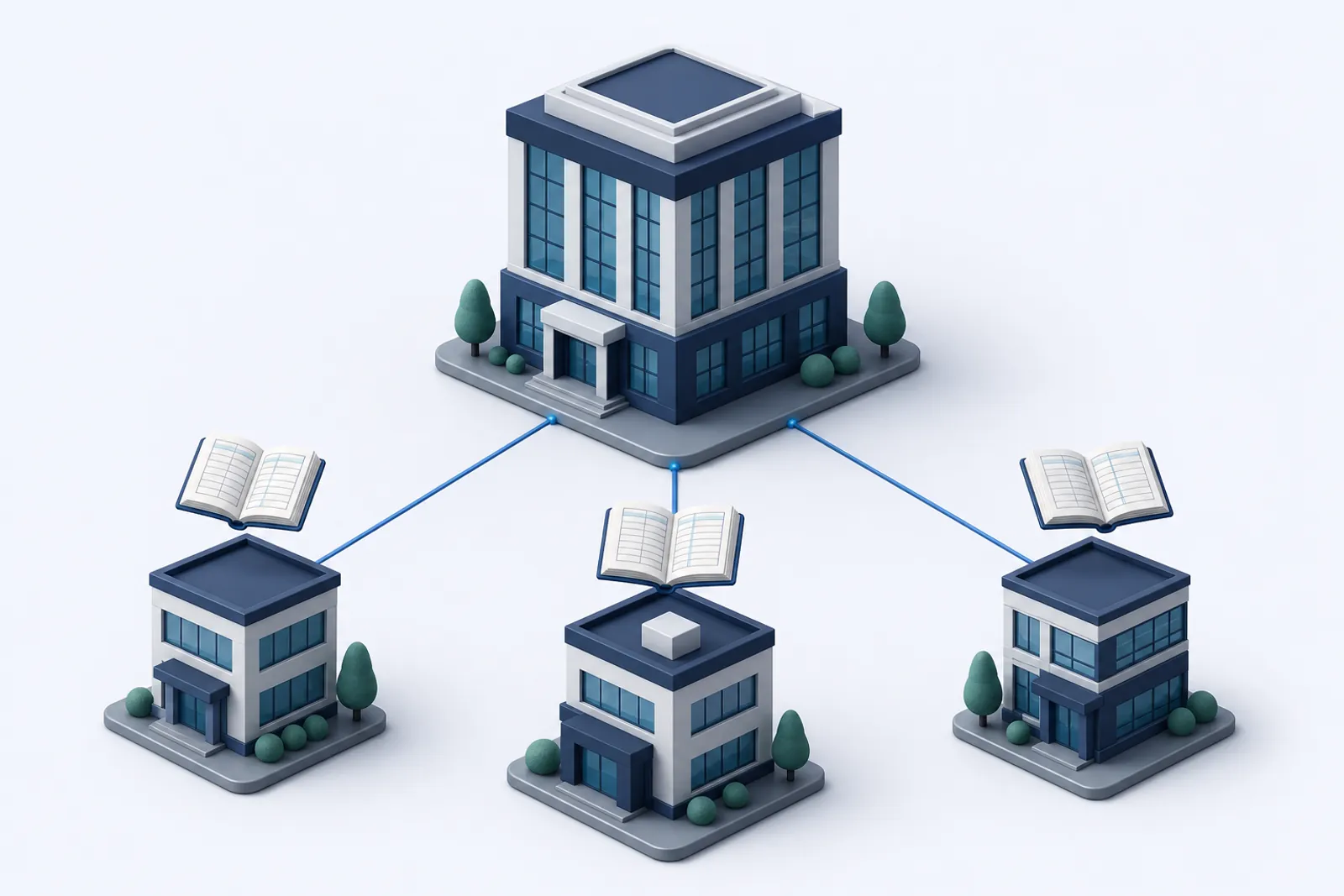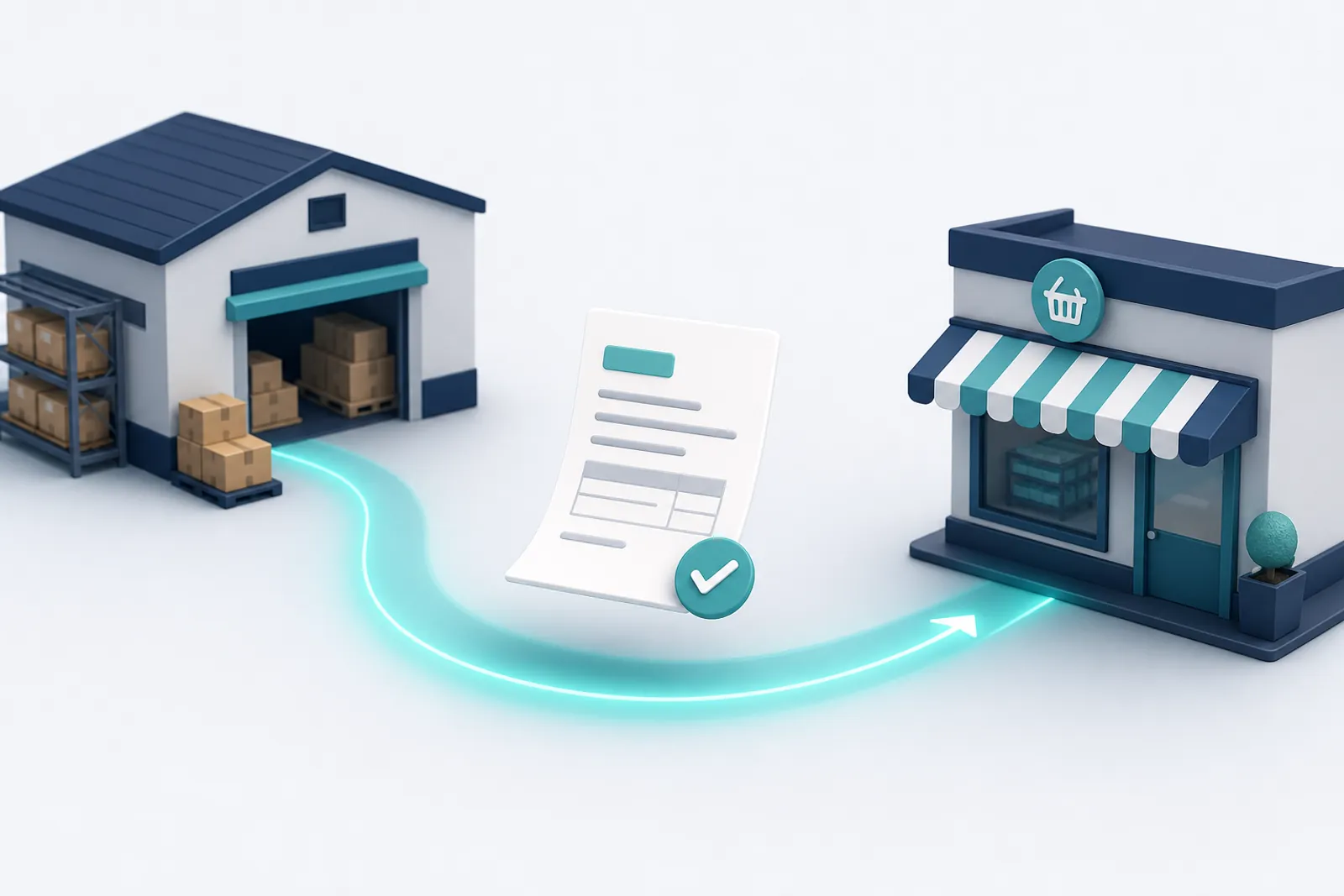
Consolidation combines the financial statements of a parent company and the subsidiaries it controls into one set of group statements, as if the group were a single company. Intercompany eliminations are the adjustments that remove transactions and balances between group members, so the group does not report revenue it earned from itself, debts it owes to itself or profit on goods that never left the group.
This guide walks through a complete consolidation of a parent and an 80% owned subsidiary, step by step, with every elimination entry and a worksheet that balances. It is written for finance leads at small and mid-sized groups who prepare consolidated statements in a spreadsheet from each entity's books.
Consolidation at a glance
| Question | Short answer |
|---|---|
| Which standard applies? | IFRS 10 Consolidated Financial Statements under IFRS; ASC 810 Consolidation under US GAAP |
| Who must be consolidated? | Every entity the parent controls, not only those it owns more than 50% of |
| How much of a subsidiary is added? | 100% of each line, then the outside owners' share is shown as non-controlling interest |
| What is eliminated? | Intragroup revenue, costs, balances, loans, interest, dividends, unrealised profit and the investment against acquired equity |
| What is goodwill? | Consideration paid plus non-controlling interest minus the fair value of identifiable net assets acquired (IFRS 3, ASC 805) |
| Does the subsidiary's own ledger change? | No. Eliminations live only in the consolidation worksheet |
What is consolidation in accounting?
Consolidation is the process of presenting a parent and its subsidiaries as one economic entity. You start from each entity's own trial balance or statements, add them together line by line, and then post adjustments that exist only at group level.
Two points surprise people the first time:
- You add 100% of a subsidiary even if you own 80% of it. The 20% that belongs to outside shareholders is shown separately as non-controlling interest (NCI) in equity and as a share of profit.
- Eliminations are never posted in the subsidiaries' books. Each company keeps its legal ledger. The adjustments belong to the consolidation worksheet, which is why separate, clean books per entity matter so much. The multi-entity accounting guide explains how to structure them.
When does a parent have to consolidate a subsidiary?
A parent consolidates an entity when it controls it. Under IFRS 10, control has three elements: power over the investee's relevant activities, exposure or rights to variable returns from it, and the ability to use that power to affect those returns. Owning a majority of voting rights usually gives control, but contracts, potential voting rights and de facto control can create it below 50%.
US GAAP reaches a similar answer through two models in ASC 810: the variable interest entity (VIE) model, which asks who is the primary beneficiary, and the voting interest model for everything else. The IFRS vs US GAAP guide compares the two approaches.
Associates (significant influence, usually 20% to 50%) are not consolidated. They are accounted for with the equity method under IAS 28 or ASC 323, so their revenue and balances never enter the group lines.
What gets eliminated on consolidation?
IFRS 10 (paragraph B86) requires intragroup assets and liabilities, equity, income, expenses and cash flows to be eliminated in full. In practice that means six families of entries:
| Elimination | Debit | Credit | Why |
|---|---|---|---|
| Investment vs acquired equity | Subsidiary share capital and pre-acquisition reserves, goodwill | Investment in subsidiary, NCI | The parent cannot own itself |
| Intercompany sales and purchases | Revenue | Cost of sales | The group sold nothing to outsiders |
| Unrealised profit in inventory | Cost of sales | Inventory | Group inventory must be at the group's original cost |
| Intercompany receivables and payables | Payables | Receivables | The group does not owe itself money |
| Intercompany loans and interest | Loan payable, interest income | Loan receivable, interest expense | Same as above for financing |
| Intragroup dividends | Dividend income (and NCI) | Dividends declared by the subsidiary | Profit moved inside the group is not income |
A worked consolidation example
Northwind Holdings (the parent) bought 80% of Harbor Supplies on 1 January 2025 for 640,000. On that date Harbor's equity was 700,000 (share capital 300,000 and retained earnings 400,000), and the fair value of its identifiable net assets equalled their book value. Both companies report in the same currency and close on 31 December. We prepare the consolidated statements for the year ended 31 December 2026.
Step 1: calculate goodwill and NCI at acquisition
Northwind measures NCI at its proportionate share of net assets.
| Item | Amount |
|---|---|
| Consideration paid | 640,000 |
| Plus NCI (20% of 700,000) | 140,000 |
| Less fair value of net assets acquired | (700,000) |
| Goodwill | 80,000 |
If Northwind had chosen to measure NCI at fair value (say 155,000), goodwill would be 95,000 and NCI 15,000 higher. IFRS 3 allows either choice for each acquisition. US GAAP (ASC 805) requires NCI at fair value, which gives the "full goodwill" figure.
Step 2: list the intercompany transactions for 2026
Before any worksheet, collect every transaction between the two companies and confirm both sides agree:
- Harbor sold goods to Northwind for 90,000 at a 25% markup on cost (cost 72,000, profit 18,000).
- At year end Northwind still holds 30% of those goods: 27,000 at transfer price, containing 5,400 of Harbor's profit.
- Northwind owes Harbor 15,000 for the last delivery.
- Northwind lent Harbor 100,000 at 6%, so Harbor paid 6,000 of interest.
- Harbor declared and paid a dividend of 50,000: 40,000 to Northwind and 10,000 to the outside shareholders.
- Harbor earned 60,000 in 2025 and paid no dividend that year.
Tip: This list is the real work of consolidation. If Northwind recorded the purchase at 89,400 or Harbor forgot the interest invoice, every later step is wrong. That is why automating the second side of intercompany entries pays off; see the intercompany automation guide.
Step 3: the individual income statements
| Line | Northwind | Harbor |
|---|---|---|
| Revenue | 1,200,000 | 600,000 |
| Cost of sales | (780,000) | (390,000) |
| Operating expenses | (250,000) | (120,000) |
| Interest income | 6,000 | 0 |
| Interest expense | 0 | (6,000) |
| Dividend income | 40,000 | 0 |
| Profit for the year | 216,000 | 84,000 |
Step 4: post the income statement eliminations
| Ref | Entry | Debit | Credit |
|---|---|---|---|
| E1 | Revenue / Cost of sales (intercompany sales) | 90,000 | 90,000 |
| E2 | Cost of sales / Inventory (unrealised profit) | 5,400 | 5,400 |
| E3 | Interest income / Interest expense | 6,000 | 6,000 |
| E4 | Dividend income / Dividends of Harbor | 40,000 | 40,000 |
| E5 | NCI / Dividends of Harbor (outside share) | 10,000 | 10,000 |
E1 removes the sale entirely. E2 then puts back the 5,400 of profit that is still sitting in Northwind's inventory: the group only earns it when the goods are sold to an outside customer.
Step 5: the consolidated income statement
| Line | Northwind | Harbor | Eliminations | Group |
|---|---|---|---|---|
| Revenue | 1,200,000 | 600,000 | (90,000) | 1,710,000 |
| Cost of sales | (780,000) | (390,000) | 90,000 and (5,400) | (1,085,400) |
| Operating expenses | (250,000) | (120,000) | (370,000) | |
| Interest income | 6,000 | 0 | (6,000) | 0 |
| Interest expense | 0 | (6,000) | 6,000 | 0 |
| Dividend income | 40,000 | 0 | (40,000) | 0 |
| Profit for the year | 216,000 | 84,000 | (45,400) | 254,600 |
A quick proof: 216,000 plus 84,000 is 300,000; remove the intragroup dividend (40,000) and the unrealised profit (5,400) and you get 254,600. Interest nets to zero.
Step 6: split profit between the parent and NCI
Because the sale was upstream (subsidiary to parent), the unrealised profit sits in Harbor's result, so NCI bears its share of the adjustment:
- Harbor's adjusted profit: 84,000 minus 5,400 = 78,600
- NCI share (20%): 15,720
- Profit attributable to owners of Northwind: 254,600 minus 15,720 = 238,880
For a downstream sale (parent to subsidiary), the whole unrealised profit would come out of the parent's share and NCI would be unaffected.
Step 7: the consolidated balance sheet
Individual balance sheets at 31 December 2026:
| Line | Northwind | Harbor |
|---|---|---|
| Goodwill | 0 | 0 |
| Property, plant and equipment | 900,000 | 700,000 |
| Investment in Harbor | 640,000 | 0 |
| Loan to Harbor | 100,000 | 0 |
| Inventory | 210,000 | 140,000 |
| Trade receivables | 180,000 | 120,000 |
| Cash | 150,000 | 54,000 |
| Total assets | 2,180,000 | 1,014,000 |
| Trade payables | 230,000 | 120,000 |
| Loan from Northwind | 0 | 100,000 |
| Share capital | 1,000,000 | 300,000 |
| Retained earnings | 950,000 | 494,000 |
| Total equity and liabilities | 2,180,000 | 1,014,000 |
Harbor's retained earnings moved from 400,000 at acquisition to 494,000 (plus 60,000 in 2025, plus 84,000 in 2026, minus the 50,000 dividend), so 94,000 is post-acquisition.
Balance sheet eliminations:
| Ref | Entry | Debit | Credit |
|---|---|---|---|
| B1 | Share capital of Harbor | 300,000 | |
| Retained earnings of Harbor (pre-acquisition) | 400,000 | ||
| Goodwill | 80,000 | ||
| Investment in Harbor | 640,000 | ||
| NCI at acquisition | 140,000 | ||
| B2 | Retained earnings of Harbor (NCI share of 94,000) | 18,800 | |
| NCI | 18,800 | ||
| B3 | Group retained earnings (80% of 5,400) | 4,320 | |
| NCI (20% of 5,400) | 1,080 | ||
| Inventory | 5,400 | ||
| B4 | Loan from Northwind / Loan to Harbor | 100,000 | 100,000 |
| B5 | Trade payables / Trade receivables | 15,000 | 15,000 |
The consolidated balance sheet:
| Line | Group |
|---|---|
| Goodwill | 80,000 |
| Property, plant and equipment | 1,600,000 |
| Inventory (350,000 minus 5,400) | 344,600 |
| Trade receivables (300,000 minus 15,000) | 285,000 |
| Cash | 204,000 |
| Total assets | 2,513,600 |
| Trade payables (350,000 minus 15,000) | 335,000 |
| Share capital (parent only) | 1,000,000 |
| Retained earnings (950,000 + 75,200 minus 4,320) | 1,020,880 |
| Non-controlling interest | 157,720 |
| Total equity and liabilities | 2,513,600 |
NCI rolls forward cleanly: 140,000 at acquisition, plus 12,000 (20% of 2025 profit), plus 15,720 (2026 share), minus the 10,000 dividend, gives 157,720. When your roll-forward agrees with the worksheet, the consolidation is internally consistent.
Unrealised profit: upstream vs downstream
Unrealised profit is profit one group company has recorded on goods or assets still held by another group company. It is removed because, from the group's point of view, nothing has been sold.
| Direction | Who recorded the profit | Effect on NCI |
|---|---|---|
| Downstream (parent sells to subsidiary) | Parent | None; the parent's share absorbs 100% |
| Upstream (subsidiary sells to parent) | Subsidiary | NCI absorbs its percentage |
| Sideways (subsidiary to subsidiary) | Selling subsidiary | NCI of the seller absorbs its percentage |
The same logic applies to fixed assets transferred at a profit: eliminate the gain, then add back the extra depreciation the buyer charges each year until the asset is fully depreciated.
Why don't intercompany balances agree?
Mismatched intercompany balances are the most common reason a consolidation does not balance. The usual causes:
- Timing. The seller invoices on 31 December, the buyer receives the goods on 2 January and books the purchase then.
- Goods or cash in transit. A payment leaves one bank on the 30th and arrives on the 1st.
- Different exchange rates. One side books at the invoice-date rate, the other at the payment-date rate. The multi-currency accounting guide shows how to keep rates consistent.
- One side never booked it. Management fees and cost recharges are the classic examples.
- Different accounts. The seller uses intercompany receivables, the buyer uses ordinary trade payables, so the reconciliation report misses it.
- Disputes. The buyer rejected part of a delivery and issued a debit note the seller has not accepted.
Agree a cut-off rule, use dedicated "due from" and "due to" accounts per counterparty, and reconcile monthly rather than at year end. The month-end close checklist puts that reconciliation on day two of the close.
How to prepare consolidated financial statements step by step
- Confirm the group structure, ownership percentages and which entities are controlled.
- Align accounting policies, reporting dates and the chart of accounts mapping across entities.
- Translate any foreign subsidiary into the presentation currency (IAS 21, ASC 830).
- Reconcile every intercompany balance and transaction pair and fix differences at source.
- Export each entity's trial balance and add them in the worksheet.
- Post the investment elimination, goodwill and NCI at acquisition.
- Eliminate intercompany sales, balances, loans, interest and dividends.
- Remove unrealised profit in inventory and on transferred assets.
- Allocate post-acquisition profit and reserves between the parent and NCI.
- Check that the worksheet balances, roll forward NCI and goodwill, and draft the group statements.
How Ledgeriano helps with consolidation
Ledgeriano does not produce consolidated statements automatically. What it does is take care of the inputs that make consolidation slow:
- Separate, complete books per entity. Each subsidiary is its own business with its own base currency, chart of accounts template (IFRS, US GAAP, European PCG, GCC IFRS or small business) and fiscal years. See features.
- Matched intercompany entries. A workflow creates the purchase in the buyer the moment the seller posts the sale, with the same amount and party codes, so step 4 above becomes a check rather than an investigation.
- Statements and trial balances per entity with prior-year comparison and CSV export, ready to paste into the worksheet. Through the accounting API you can pull trial balances for every entity into your own consolidation file or script.
- Lock dates per entity so nobody changes a subsidiary's numbers after the group pack is assembled.
If your group needs automated eliminations, translation of dozens of subsidiaries and statutory consolidation packs, a dedicated consolidation tool on top of clean entity books is the right call. For a group of two to ten companies, a well-designed worksheet fed by reliable entity ledgers is usually enough.
Common consolidation mistakes
- Eliminating only the parent's share of intercompany sales. Eliminate 100%; NCI is dealt with separately.
- Forgetting to reverse last year's unrealised profit when the goods are sold this year.
- Posting eliminations into a subsidiary's legal ledger, which corrupts its own statements.
- Leaving pre-acquisition reserves in group retained earnings.
- Ignoring intercompany items in the cash flow statement: intragroup loans and dividends must come out there too.
- Using different fiscal year ends without adjusting for significant transactions in the gap (IFRS 10 allows a difference of up to three months).
How to consolidate a parent and a subsidiary
- 1
Confirm control and ownership
List every entity the parent controls under IFRS 10 or ASC 810 and its ownership percentage.
- 2
Reconcile intercompany pairs
Agree every intercompany balance and transaction between the two ledgers and fix differences in the source books.
- 3
Add the trial balances
Export each entity's trial balance in the presentation currency and add them line by line in the worksheet.
- 4
Eliminate the investment
Remove the investment against the subsidiary's equity at acquisition and record goodwill and NCI.
- 5
Eliminate intragroup items
Remove intercompany sales, receivables and payables, loans, interest and dividends.
- 6
Remove unrealised profit
Reduce inventory and increase cost of sales by profit on goods still held inside the group.
- 7
Allocate to NCI and check
Split profit and post-acquisition reserves between the parent and NCI, then confirm the worksheet balances and NCI rolls forward.
Frequently asked questions
What are intercompany eliminations?
+
They are worksheet adjustments that remove transactions and balances between companies in the same group, such as intercompany sales, receivables and payables, loans, interest, dividends and unrealised profit, so the consolidated statements show only dealings with outside parties.
Do you eliminate 100% of intercompany transactions if you own less than 100%?
+
Yes. IFRS 10 and ASC 810 require intragroup balances and transactions to be eliminated in full. Ownership below 100% is handled by allocating part of the subsidiary's profit and net assets to non-controlling interest, not by eliminating less.
How do you calculate non-controlling interest?
+
At acquisition, NCI is either its proportionate share of the fair value of net assets or its fair value (IFRS 3 allows both; US GAAP requires fair value). Each year add the NCI share of the subsidiary's adjusted profit and subtract dividends paid to the outside shareholders.
How is goodwill calculated on consolidation?
+
Goodwill equals the consideration transferred plus the non-controlling interest (plus any previously held interest) minus the fair value of the identifiable net assets acquired. In the example in this guide: 640,000 plus 140,000 minus 700,000 equals 80,000.
What is unrealised profit in inventory?
+
It is profit one group company recorded on goods that another group company still holds at the reporting date. It is removed by debiting cost of sales and crediting inventory, and it is recognised when the goods are later sold outside the group.
Are eliminations posted in the subsidiary's books?
+
No. Each entity keeps its own legal ledger unchanged. Eliminations are recorded only in the consolidation worksheet or consolidation system.
What is the difference between consolidation and the equity method?
+
Consolidation adds 100% of a controlled subsidiary's lines and shows NCI. The equity method, used for associates and joint ventures, records a single investment line that grows with the investor's share of profit and shrinks with dividends received.
Can Ledgeriano consolidate my group automatically?
+
No. Ledgeriano keeps separate books per entity, keeps intercompany entries matched through workflows and exports trial balances and statements to CSV or through the API. The consolidation worksheet and its eliminations are prepared from those outputs.
Reviewed by our accounting specialists. Published: